| |

|
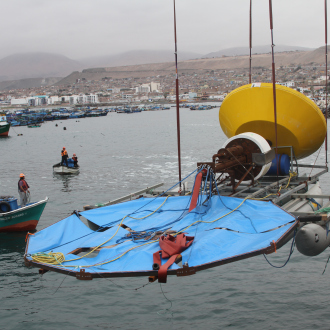
Our technology uses kinetic wave energy to bring up higher-nutrient
deep water. In the presence of sunlight, and assuming appropriate
ocean environmental conditions, the enhanced nutrients generate blooms
of phytoplankton which absorb dissolved CO2 and generate oxygen
through the process of photosynthesis. When the phytoplankton
are consumed by higher trophic levels such as zooplankton and
fish, or when the phytoplankton die, some of the absorbed CO2
as well as other biochemical contents sink. Some of this is
remineralized and suspended in mid ocean depths, some sinks
to the ocean floor, and some is sent back up to the surface
by natural upwelling events (currents, storm-generated upwelling,
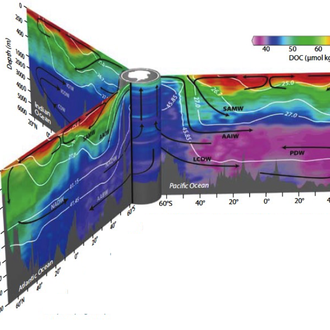
heating/cooling cycles such as El Nino, etc.). This "biological
pump" is the principle physical process responsible for
the higher concentrations of nutrients, and CO2, which are found
beneath the upper sunlit zone (typically 50 to 80 meters) of
the ocean. Within the upper ocean's sunlit zone, however,
the nutrients are quickly consumed, with the result that phytoplankton
blooms diminish until upwelling brings up more nutrients.
Until recently, conventional wisdom regarding limits to phytoplankton
productivity in the upper sunlit zone of the ocean cited the Redfield
Ratio as the limiting factor to how much net benefit could accrue
from wave-driven ocean pumps. The Redfield Ratio limits the amount
of carbon that each phosphate atom can recycle. For the average
of all the ocean is it 106 carbon atoms for every phosphate atom.
If CO2 recycling efficiency is limited by phosphate, and deeper water
contained proportional concentrations of nitrate, phosphate and dissolved
CO2, then net additional absorption from upwelling of phosphate would
be balanced by the higher concentrations of CO2 brought upward - at
best a zero sum game.
But Professors David M. Karl from University of Hawaii, and Ricardo
Letelier from Oregon State University have recently published a peer-reviewed
paper which hypothesizes that upwelling of certain deeper waters (generally
300m or more) can result in a secondary bloom governed by nitrate
as the limiting nutrient - with the result that several-fold greater
net absorption of CO2 is possible. The absence of nitrate causes diazotrophic
(nitrogen fixing) phytoplankton to dominate the second bloom, with
super-Redfield C:P ratios of >200:1. Click
this link to read their paper.
Given this new Karl-Letelier hypothesis about potential net sequestration
of CO2, if ocean biogeochemical conditions are suitable for generating
primary and secondary blooms, and given the potential for a single
Atmocean pump to produce nominal upwelling volume of 200,000 cubic
meters per day (consistent with 3 meter wave height), initially we
estimate precision upwelling could result in net additional sequestration
of about 60 tons CO2 per pump per year, with the significant added
benefit of 1.5 tonnes annual increase in fish biomass. Many elements
of this process remain to be tested, including the multiple effects
over many seasons and in different ocean environments, and how the
upper, mid, and deep-ocean concentrations of nutrients and CO2 could
transition over longer time periods.
To initiate testing of the Karl-Letelier Hypothesis, in May 2008 Atmocean
participated in an ocean test of three pumps in the Pacific about
60nm north of Hawaii. This test is featured on the Discovery Channel
Project Earth episode "Hungry Oceans". To order the DVD
set of all eight Project Earth episodes, visit the Discovery Channel
store, or contact Atmocean to purchase a DVD of just the "Hungry
Oceans" episode. In brief, while not all the experimental goals
were achieved (due to structural failures, and an inappropriate pump
deployment method), the tests conclusively proved our capability to
pump up nutrient-rich water from 300m deep in the open ocean, solely
using wave energy. Since we learn more from failure than success,
these tests prompted a new durable pump design for extreme ocean conditions.
We expect this new design, which very closely mimics natural ocean
mixing processes, can be produced and deployed at equal or lower cost
than our "original" design. If comprehensive future testing
demonstrates that the environmental consequences are manageable and
achieves permanent, additional, net CO2 absorption in the oceans,
this could lead to large-scale commercial implementation.
*U.S. and International Patents Pending
|
|